
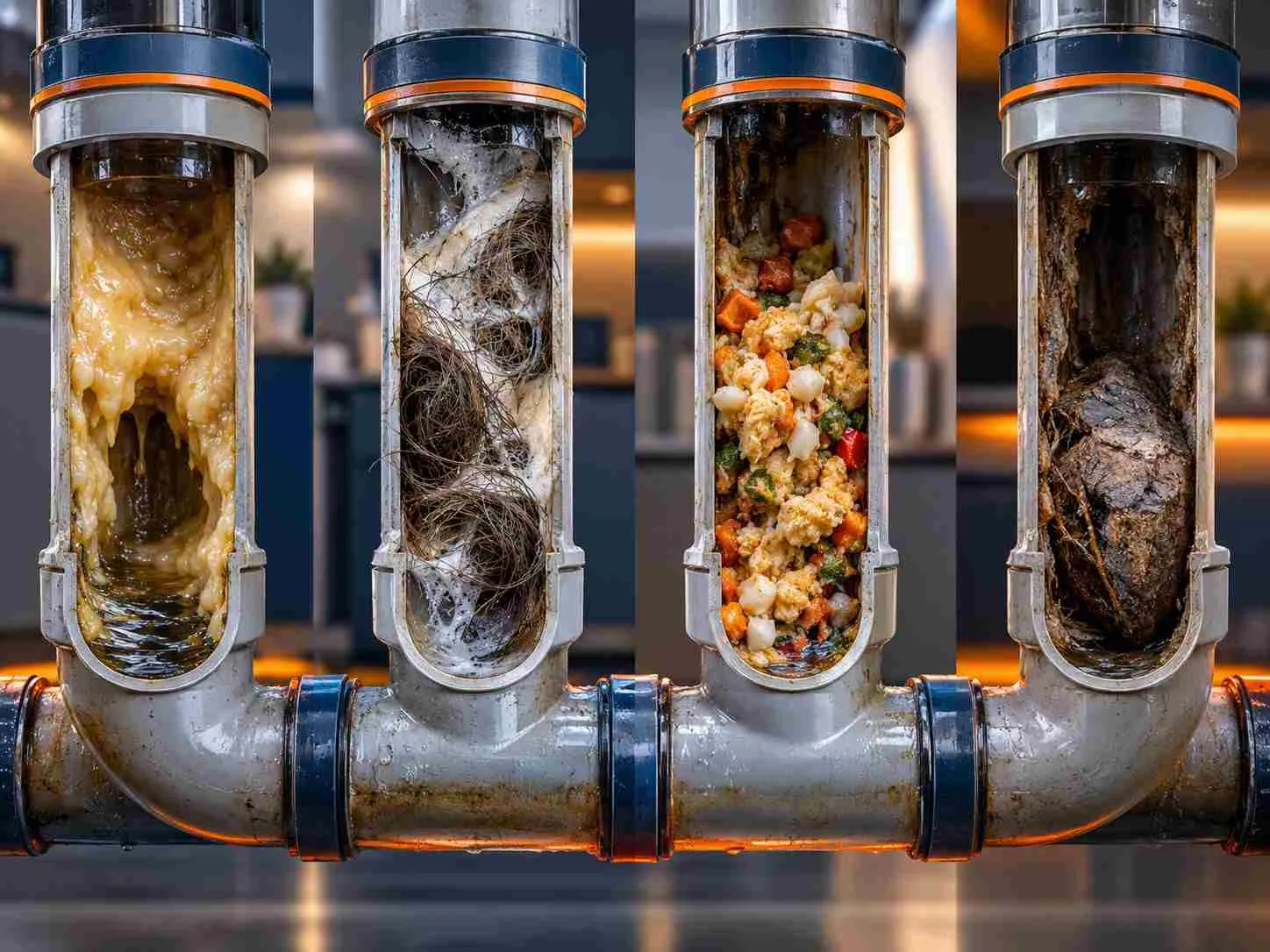
Common Causes of Clogged Drains
| Cause | Often Appears Around | Useful Clue |
|---|---|---|
| Fats, oils and grease | Kitchen sinks | Drain gradually becomes slower |
| Food debris | Kitchen drains | Clog follows cooking or cleanup |
| Hair and soap residue | Showers, tubs, bathroom sinks | Water drains slower over time |
| Wipes and hygiene products | Toilets and deeper drainage | Toilet or connected drains may back up |
| Foreign objects | Individual fixtures | Problem may begin suddenly |
| Tree roots | Underground sewer piping | Problems may recur or affect more fixtures |
| Pipe defects or displacement | Deeper drain or sewer lines | Cleaning may provide only temporary relief |
This table is a starting point, not a diagnosis. Several causes can create similar symptoms.
1. Fats, Oils and Grease
Kitchen drainage problems often develop when fats, oils and grease—commonly called FOG—enter the sink.
Liquid grease may appear harmless while it is warm, but it can cool and stick to pipe surfaces. Other debris then catches against that buildup and gradually reduces the open space available for water.
Sarasota County specifically warns residents not to pour FOG down drains and explains that small amounts accumulate over time. The county also notes that pouring hot water down the sink does not eliminate the problem because grease can cool and adhere to the pipe. See the county'sFOG guidance.
If the problem is limited to the kitchen sink, our kitchen drains page explains that service separately.
2. Food Debris
Food scraps can enter a kitchen drain during rinsing and cleanup.
Even small particles can become part of a larger restriction when they combine with grease or other material already coating the pipe.
A garbage disposal does not make every food item safe for the drainage system. The EPA notes that food waste adds solids to septic systems, while Sarasota County recommends scraping food waste into the trash rather than sending it down the drain.
3. Hair and Bathroom Residue
Bathroom drains face a different type of buildup.
Hair can collect around drain openings and inside the line. Soap residue and other bathroom material can attach to that hair, creating a restriction that becomes tighter over time.
Common signs include:
a shower that drains more slowly each week;
water collecting around your feet;
a tub that takes longer to empty;
a bathroom sink that repeatedly needs clearing.
Problems involving these fixtures belong more naturally with our bathroom drains information.
4. Wipes and Other Flushed Materials
A toilet is designed to carry human waste and toilet paper—not every product that fits through the opening.
The EPA identifies baby wipes, facial wipes, sanitary products, and other inappropriate materials as potential causes of sewer blockages. It specifically notes that even some products labeled “flushable” can contribute to problems.
For septic properties, EPA guidance is even simpler: flush only human waste and toilet paper. See itsseptic guidance.
5. Objects That Enter the Drain
Some clogs happen suddenly because something enters a fixture that should not be there.
Small objects can fall into sinks or toilets, while excessive paper or other material can create an immediate restriction.
A sudden blockage after a known event is different from a drain that has gradually slowed for months. That timeline is useful information when describing the problem.
6. Tree Roots in Underground Lines
Roots do not normally enter intact piping. The concern arises when roots reach defects, joints, cracks, or openings in underground sewer piping.
The EPA lists tree-root intrusion through sewer defects or openings as one cause of sewer blockages.
Root-related problems deserve their own diagnosis rather than assuming every recurring clog needs the same cleaning method. We will cover this subject separately in our tree roots guide.
7. Damaged or Displaced Pipe
Sometimes the material inside the pipe is not the entire problem.
A damaged, shifted, deteriorated, or poorly aligned section of drainage piping can interfere with normal flow or create a place where debris repeatedly collects.
One clue is a clog that returns despite previous clearing. That does not prove pipe damage, but it is a reason not to assume the issue is simply another surface-level blockage.
Why Does the Same Drain Keep Clogging?
Recurring clogs usually mean the conditions that allowed the restriction to form are still present.
That may involve leftover buildup, repeated grease disposal, hair accumulating again, inappropriate flushed materials, or a deeper line condition.
Tell the service provider:
which fixture clogs;
how often it happens;
what was done previously;
how long normal drainage lasted afterward.
That history is more useful than simply saying, “It is clogged again.”
What If Several Drains Are Clogged?
That is a different question.
When multiple fixtures slow down or back up around the same time, the problem may involve shared drainage rather than several unrelated fixture clogs.
Our slow drains guide explains that pattern in detail without duplicating this article's cause-focused intent.
How Can You Reduce Future Clogs?
Start with what enters the plumbing.
Keep grease and cooking oil out of sinks, scrape food waste into the trash, use drain strainers where practical, and avoid treating toilets like waste bins.
If a drain repeatedly clogs despite changing those habits, the next step is to determine why the restriction keeps returning, rather than repeatedly using temporary fixes.
When Does Professional Drain Cleaning Make Sense?
Consider professional evaluation when a drain repeatedly blocks, water stops flowing normally, previous clearing provides only short-term relief, or the symptoms begin spreading to other fixtures.
The appropriate method depends on the fixture and the condition of the drainage line. Stronger methods such as hydro jetting are useful in some situations but are not automatically the correct answer for every clog.
You can compare available options through our drain services guide before deciding what fits the problem.