
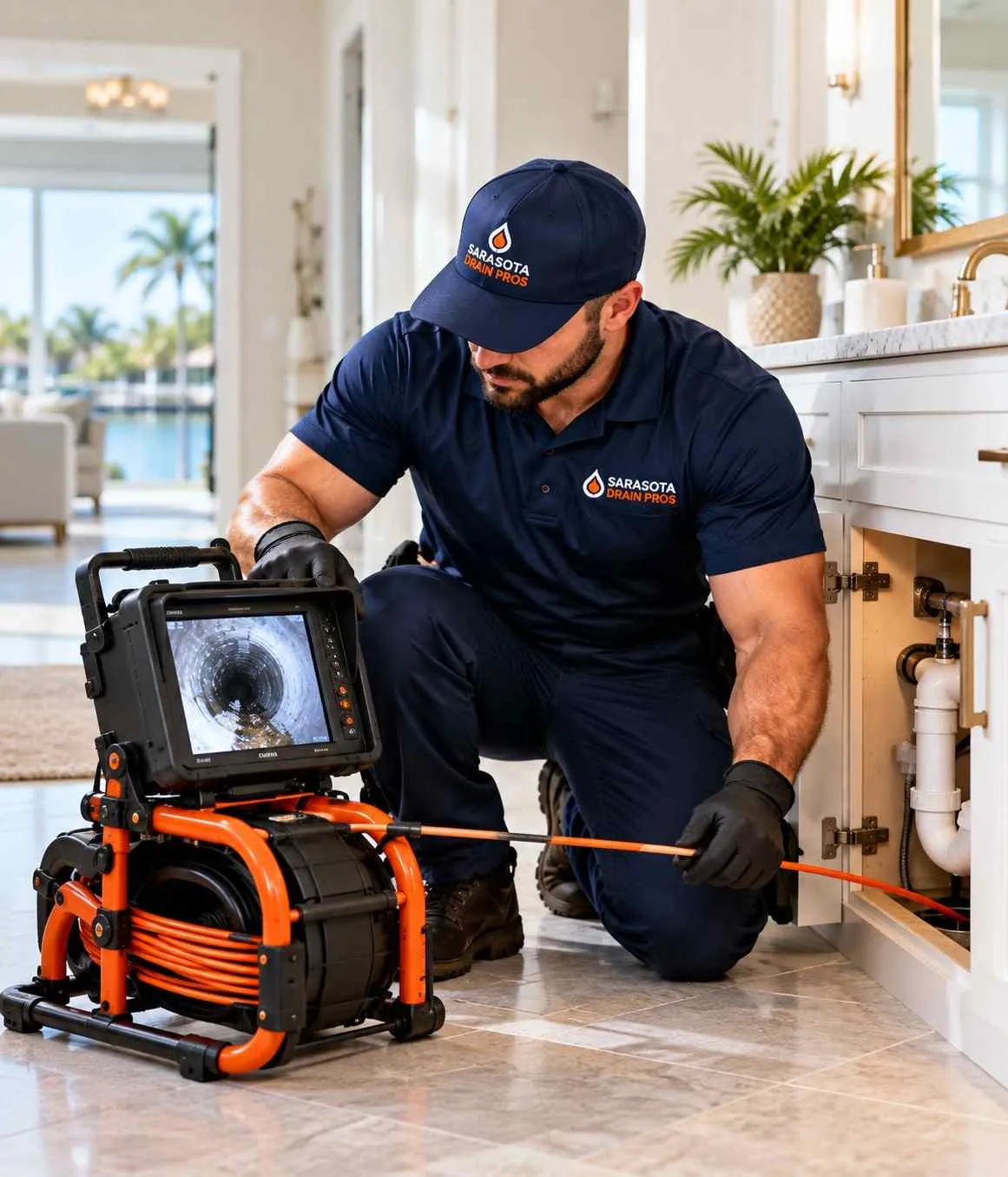
What Is a Drain Camera Inspection?
A drain or sewer camera inspection uses a waterproof camera attached to a flexible push cable.
The camera travels through an accessible drain or sewer line while a technician views the inside of the pipe on a monitor.
Depending on the line and equipment, an inspection may reveal:
roots entering the pipe;
cracks or broken sections;
displaced or open joints;
heavy buildup;
obstructions;
sections that have collapsed or changed shape;
other visible pipe defects.
EPA sewer-inspection guidance recognizes CCTV and camera inspection as established methods for identifying structural defects, root intrusion, grease, obstructions, and abnormal pipe joints. (epa.gov)
When Is a Camera Inspection Worth Considering?
| Situation | Camera May Help |
|---|---|
| One first-time sink clog | Usually not the first step |
| Same blockage keeps returning | Yes |
| Root intrusion is suspected | Yes |
| Drain cleaning repeatedly fails | Yes |
| Pipe damage is suspected | Yes |
| Several fixtures are affected | Possibly, after initial diagnosis |
| Completely blocked line full of water | Cleaning may need to come first |
The most important point is that a camera should answer a specific diagnostic question.
1. The Same Clog Keeps Returning
A drain that works normally after clearing and then repeatedly blocks again deserves a closer look.
Recurring problems can result from conditions such as:
root intrusion;
heavy deposits;
damaged pipe;
open or displaced joints;
improper pipe alignment;
another structural problem.
Clearing the blockage restores flow. It does not necessarily explain why the blockage returned.
Our clog causes guide covers the broader causes of drain restrictions.
2. Tree Roots May Be Inside the Line
Roots are one situation where seeing the pipe can change the next step.
A camera may help confirm whether roots are actually present and, after sufficient cleaning, may help identify where they are entering the line.
That distinction matters because cutting roots and fixing the opening that allowed root intrusion are different jobs.
Our tree roots guide explains that relationship in more detail.
3. There Is Concern About Pipe Damage
Repeated blockage can sometimes involve more than material inside the pipe.
A camera inspection may reveal visible signs of:
Cracks
Openings or fractures in the pipe wall may allow leakage or root intrusion.
Misaligned Joints
Pipe sections that no longer connect correctly can create flow problems or places where debris collects.
Collapsed Sections
A severely damaged section may physically reduce or stop wastewater flow.
Deterioration
Older or compromised piping may show visible surface or structural problems.
A camera can provide useful evidence before someone recommends more invasive repair work.
4. Drain Cleaning Has Not Solved the Problem
If a line has already been cleaned but the same drainage problem continues, repeating the same method without additional information may not be useful.
Inspection can help answer:
Did the cleaning remove the restriction, or is another condition still affecting the pipe?
RIDGID's current professional diagnostic guidance recommends sewer-camera inspection when blockages repeatedly occur, previous cleaning attempts have failed, root intrusion is suspected, or structural defects may be involved. (ridgid.com)
Should the Drain Be Cleaned Before the Camera Goes In?
Sometimes, yes.
A common misconception is that a camera can simply be pushed through any blocked line and immediately show the problem.
That is not always possible.
Seattle Public Utilities explains that cameras cannot see effectively through standing wastewater in a fully blocked line. The blockage may need to be cleared first so the camera can inspect the pipe condition behind it.
Its officialsewer guidance recommends camera inspection after blockage removal when the goal is to evaluate pipe condition.
EPA guidance likewise notes that sewer cleaning should be considered before inspection so the camera has adequate clearance and defects are easier to see. (epa.gov)
What a Camera Inspection Cannot Tell You
A camera is useful, but it has limits.
It cannot always:
see through dirty or standing water;
determine pipe condition where buildup completely blocks the view;
automatically identify the exact material causing every obstruction;
repair anything it finds;
prove that every visible imperfection is causing the current symptoms.
The video needs interpretation in the context of the drainage problem.
Camera Inspection or Drain Cleaning First?
Use the purpose of the visit to decide.
Cleaning First
Cleaning may come first when the immediate goal is restoring flow through a blocked line.
Inspection First
Inspection may make sense early when the line still provides enough access and there is a specific concern about structural condition or a recurring problem.
Cleaning Then Inspection
This combination can be especially useful when an obstruction must first be removed before the pipe can be properly evaluated.
The cleaning method itself is a separate decision. Our jetting comparison explains how mechanical snaking and hydro jetting differ.
What Should You Ask After an Inspection?
Do not leave with only “the camera found something.”
Ask:
Where is the problem located?
What does the video actually show?
Is the issue buildup or pipe damage?
Does the line need cleaning, monitoring, or repair?
Can I receive a copy of the inspection video?
Seattle Public Utilities specifically recommends getting the probable cause and location of a sewer problem documented and requesting a copy of inspection footage when available. (seattle.gov)
Does Every Clogged Drain Need a Camera?
No.
A first-time localized sink, shower, or tub clog does not automatically justify video inspection.
Camera inspection becomes more valuable when the problem is recurring, unexplained, deeper in the drainage system, or potentially related to pipe condition.
If several fixtures begin changing together, first understand the drainage pattern through our multiple drains guide rather than assuming a camera is automatically required.